

Something massive just happened in ecommerce.
And if you blinked, you might have missed it.
Google Gemini quietly transformed into a full-blown shopping platform.
Users can now discover products, compare options and complete purchases without ever leaving the AI conversation.
- No website visits.
- No app switching.
- No traditional shopping journey at all.
Just a conversation that ends with a confirmation email.
This isn’t a future prediction. It’s happening right now through AI shopping integrations with Walmart, Target, Shopify, Wayfair, Etsy, and over 20 other major retailers.
The question isn’t whether this will change ecommerce.
It’s whether your brand will be part of it when it does.
What Is Google Gemini’s New Shopping Feature?
For those wondering what Google Gemini is doing differently now, the answer is…
Everything.
For years, we’ve operated under the same basic assumption:
Customers search. They browse. They compare. They visit your site. Maybe they add to cart. Eventually, they buy.
That entire journey just got compressed into a single chat window.
Someone types “gear for a ski trip” into the Gemini app.
They see relevant products.
They checkout.
Done.
No traditional search results page.
No clicking through to your store.
No abandoned cart email sequence.
The transaction happens inside the AI itself.
This is AI commerce in its purest form and it fundamentally rewrites the rules of product discovery.
Google has partnered with the biggest names in retail to make this seamless. We’re talking Walmart, Target, Shopify merchants, Wayfair, Etsy, and a growing list of commerce platforms.
If your products live in that ecosystem you have a shot at appearing in these AI-driven purchases.
If they don’t?
You’re invisible at the exact moment someone’s ready to buy.
How Google Gemini Powers AI Shopping
Here’s the technical backbone making all of this possible.
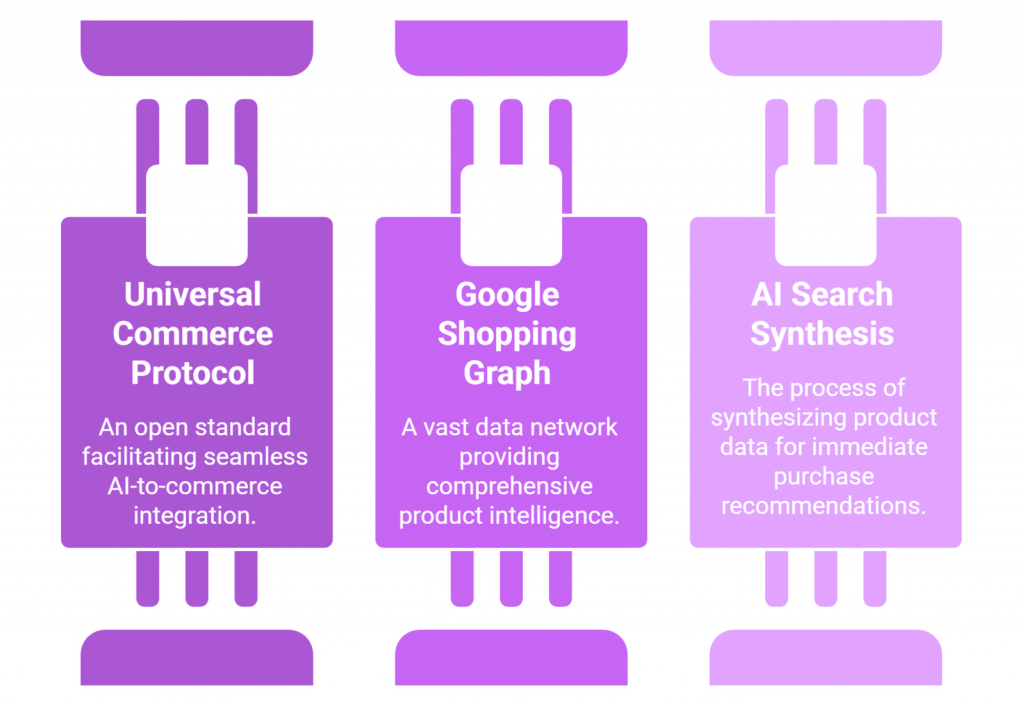
Google launched something called the Universal Commerce Protocol, or UCP. It’s an open commerce standard built in collaboration with major retailers.
Think of it as the translation layer between AI conversation and actual commerce infrastructure.
UCP lets Google Gemini handle everything, product discovery, comparison, payment processing without ever kicking users out of the chat experience.
But where does Gemini search get its product intelligence?
From Google’s Shopping Graph.
This is the massive data network Google has been building for years. It pulls signals from YouTube videos, manufacturer websites, online stores, product detail pages, Google Merchant Center, Google Manufacturer Center, product testing data, and customer reviews.
Every piece of product information Google has ever indexed feeds into this system.
When someone asks for ski gear recommendations through AI search, it’s not just searching. It’s synthesizing everything Google knows about ski products, retailers, pricing, availability, and reviews.
Then it serves up options you can buy immediately.
That’s AI commerce operating at scale.
Why This Changes Everything for Ecommerce Brands
Let’s talk about what this really means for your business.
We’ve entered the era of zero-click conversions.
Not zero-click searches, we’ve had those for years.
Zero-click purchases.
The customer never visits your website. Never sees your carefully designed product pages. Never enters your conversion funnel.
They just buy through Google Gemini.
This creates a brutal new reality.
If your products aren’t surfacing in AI shopping experiences, you don’t exist when purchase intent happens.
Not “you rank lower.” Not “you get fewer clicks.”
You simply aren’t in the conversation.
The discovery phase, consideration phase, and purchase phase are collapsing into a single AI interaction. Brands that appear in that interaction capture the sale.
Everyone else watches from the sidelines.
What Happens to Brands That Ignore AI Commerce
Here’s the uncomfortable truth.
Most brands are going to ignore this for too long.
They’ll wait until the Gemini app becomes undeniably dominant for shopping. Until their competitors have already optimized. Until the early-mover advantage has evaporated.
Then they’ll scramble to catch up.
Don’t be that brand.
The companies preparing now will capture incremental intent signals and direct conversions before the market adapts. They’ll build a presence in AI shopping while others are still debating whether it matters.
This is especially critical in product-heavy categories.
Gemini search and similar AI surfaces are already starting to influence discovery and consideration metrics. The brands showing up in these experiences are shaping purchase decisions before traditional marketing even enters the picture.
By the time a customer hits traditional search or visits your site, they may have already made their choice inside an AI chat.
You just didn’t know you were competing there.
How to Get Your Products Inside Google Gemini
So what do you actually do about this?
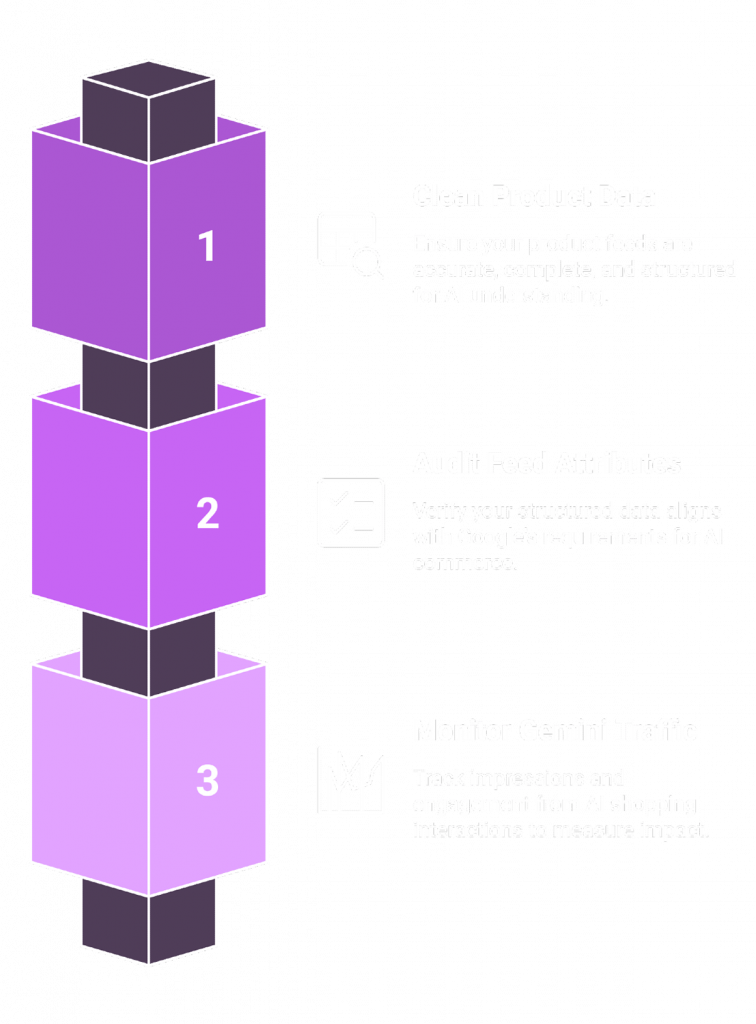
Start with your product data.
Your feeds need to be clean, complete, consistently available, and structured in a way AI search can understand. Messy data means missed opportunities.
This isn’t about keywords anymore. It’s about comprehensive product information that AI systems can parse and present confidently.
Next, audit your feed attributes and schema markup.
Google’s Shopping Graph pulls from specific data sources. If your structured data doesn’t align with what Google Gemini needs, your products won’t surface in AI commerce conversations.
Make sure your catalog syndication matches Google’s requirements. The technical details matter more than ever when an AI is deciding which products to recommend.
Finally, start monitoring Gemini as a traffic source.
Track impressions and engagement from AI shopping interactions over the coming weeks. Build baseline data now so you can measure the impact as this channel grows.
The brands treating the Gemini app as a measurable commerce channel, not just a curiosity, will optimize faster than everyone else.
Why AI SEO and GEO Matter More Than Ever
Here’s the bigger picture most brands are missing.
Optimizing for Google Gemini isn’t a one-off project.
It’s part of a fundamental shift in how search works.
This shift is part of the AI SEO/GEO era.
Traditional SEO focused on ranking in search results. AI SEO focuses on being the answer inside AI-generated responses. Generative engine optimization (GEO) takes it further by optimizing specifically for how generative AI systems like Google Gemini retrieve, synthesize, and present information.
The good news?
Strong SEO foundations actually accelerate your AI search success.
- Clean structured data.
- Comprehensive product information.
- Authoritative content signals.
These fundamentals matter even more when AI systems are deciding which brands to surface during purchase conversations.
Think of GEO as the evolution of SEO and not its replacement.
Brands already investing in solid SEO practices have a head start. Those who ignored the basics are now scrambling twice as hard.
The lesson is clear. AI commerce readiness and traditional search optimization aren’t competing priorities. They’re the same priority viewed through different lenses.
The Future of AI Search and Commerce
We’re witnessing the beginning of something much bigger.
AI search is becoming a first-touch commerce surface.
Not just a discovery tool.
Not just a research assistant.
An actual place where transactions happen.
This trend will accelerate. More retailers will join. More product categories will be covered. More consumers will get comfortable buying through AI chat.
The window for early preparation is open right now.
Brands who move first will establish a presence in Google Gemini before the competition catches on. They’ll capture purchase intent that competitors don’t even know exists yet.
This is your moment to get ahead.
- Audit your AI commerce readiness.
- Align your structured data with Google’s expanding requirements.
- Track performance shifts tied to Google Gemini shopping interactions.
The checkout counter just moved inside the AI.
Make sure your products are on the shelf.